In today’s increasingly regulated business environment, knowing who your customers are is essential for managing financial crime risks and maintaining regulatory compliance. Businesses operating in sectors such as financial services, accounting, legal services, real estate and corporate services need robust processes to identify customers, verify their identities and understand the risks associated with business relationships.
KYC and Customer Due Diligence Services provide a structured approach to customer verification, risk assessment and ongoing monitoring. By combining specialist compliance expertise with technology-enabled processes, businesses can create more efficient onboarding procedures while strengthening their AML/CFT framework. At Integra Corporate, we support organisations with practical KYC, Customer Due Diligence (CDD) and wider AML/CFT compliance solutions designed around their regulatory and operational requirements.
What Are KYC And Customer Due Diligence Services?
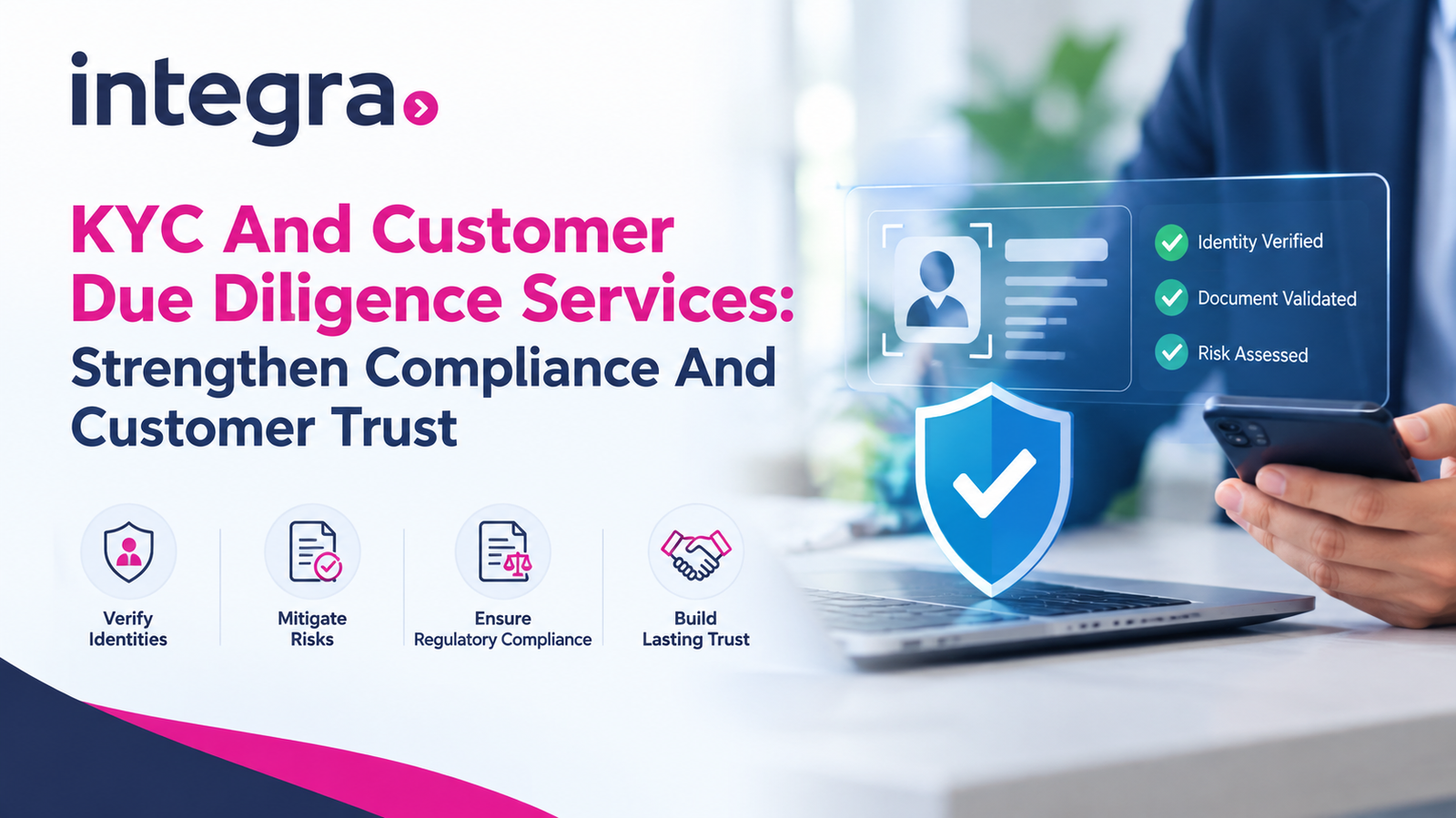
Know Your Customer (KYC) and Customer Due Diligence are closely connected components of an effective financial crime compliance programme. KYC generally focuses on establishing and verifying a customer’s identity. CDD goes further by helping a business understand the customer, the purpose and intended nature of the relationship, ownership and control structures, and the risks associated with the relationship.
UK government guidance describes CDD as the process of identifying customers and checking that they are who they claim to be. Depending on the circumstances, businesses may also need to establish beneficial ownership and understand the purpose and intended nature of a relationship. The UK’s Financial Conduct Authority (FCA) similarly states that firms should identify and verify customers and, where applicable, their beneficial owners, while gathering sufficient information to understand the risks associated with a business relationship.
Why Is KYC And CDD Important For Businesses?
Effective customer due diligence helps organisations make informed decisions before and throughout a business relationship. It can help identify inconsistencies, unusual ownership structures and other potential indicators of financial crime risk. A strong KYC and CDD process can help businesses:
- Verify customer identities and documentation
- Identify beneficial owners and controlling parties
- Understand the purpose and nature of customer relationships
- Assess customer risk
- Support AML/CFT compliance
- Identify circumstances requiring enhanced due diligence
- Maintain appropriate customer records
- Strengthen audit readiness and internal governance
- Support ongoing monitoring and periodic reviews
The FCA’s current financial crime guidance emphasises risk-based CDD and ongoing monitoring, with enhanced due diligence applied where customers present higher levels of risk.
Key Elements Of Effective Customer Due Diligence
A comprehensive CDD framework should be proportionate to the risks faced by the business and its customers. Depending on the customer and jurisdiction, KYC and CDD activities may include several important checks.
1. Identity Verification
The first step is establishing that the customer is who they claim to be. This can involve reviewing identification documents and using appropriate verification methods. Digital processes can help businesses streamline document collection and verification while maintaining appropriate records.
2. Beneficial Ownership Checks
For corporate customers, understanding who ultimately owns or controls an entity can be particularly important. Complex corporate structures may make ownership difficult to establish without appropriate investigation. The Financial Action Task Force (FATF) has strengthened its beneficial ownership standards to improve transparency around the true owners of legal entities and reduce opportunities for corporate structures to be misused for illicit purposes.
3. Customer Risk Assessment
Not every customer presents the same level of risk. A risk-based approach allows organisations to assess customers according to relevant factors and apply appropriate levels of due diligence. Factors may include customer type, geographical exposure, ownership structure, products or services, transaction expectations and other relevant risk indicators.
4. Enhanced Due Diligence
Higher-risk customers may require additional checks. Enhanced Due Diligence (EDD) can involve gathering additional information, verifying sources of funds or wealth where appropriate, and applying increased scrutiny. The FCA notes that higher-risk customers, including relevant politically exposed persons (PEPs), may require more intrusive due diligence measures.
5. Ongoing Due Diligence
KYC is not simply a one-time onboarding exercise. Customer circumstances and risk profiles can change over time. Ongoing reviews can help organisations keep customer information current and identify changes that may require further investigation or updated risk assessments. The FCA also highlights ongoing monitoring to ensure customer activity remains consistent with the organisation’s knowledge of the customer and their risk profile.
How Technology Can Improve KYC and CDD
Manual onboarding processes can become time-consuming, particularly for organisations managing large numbers of customers or operating across multiple jurisdictions. Technology-enabled compliance workflows can help centralise customer information, documentation and risk assessments. Integra’s Onbordin platform is designed to support digital onboarding, secure document collection, risk assessments and structured record keeping. Technology can support processes such as:
- Digital customer onboarding
- Document verification
- Address verification
- Facial verification
- Video KYC
- Corporate verification or KYB
- PEP and sanctions screening
- Enhanced Due Diligence
- Structured compliance records
- Ongoing due diligence
However, technology should support—not replace—appropriate compliance oversight and professional judgement.
Why Outsource KYC And Customer Due Diligence?
Maintaining an effective KYC and CDD function requires appropriate expertise, processes, documentation and ongoing oversight. For smaller organisations or businesses experiencing rapid growth, maintaining these capabilities entirely in-house may be challenging. Outsourcing selected KYC and CDD activities can provide access to specialist knowledge while helping internal teams focus on their core operations. Integra Corporate provides customer due diligence, AML/KYC support, screening coordination, enhanced due diligence assistance, compliance reviews and advisory services. The company also supports organisations that need outsourced compliance capacity or specialist assistance with individual projects.
Choose A Practical Approach To KYC Compliance
Effective KYC and Customer Due Diligence Services are about more than collecting identity documents. Businesses need processes that help them understand customers, assess risk, identify beneficial ownership and maintain appropriate oversight throughout the relationship. Regulatory expectations continue to evolve, making it important for organisations to regularly review their KYC and CDD procedures. In April 2026, the FCA published findings from a multi-firm review covering CDD, Enhanced Due Diligence and ongoing due diligence controls, highlighting the importance of effective policies, processes and compliance monitoring.
Integra Corporate combines compliance expertise with technology-enabled solutions to help organisations establish structured and practical KYC and CDD processes. From customer onboarding and verification to enhanced due diligence, screening and ongoing compliance support, Integra can help businesses build a more consistent approach to managing customer risk. If your organisation is looking to strengthen its customer onboarding and financial crime compliance framework, explore Integra Corporate’s Compliance Services to learn more about its KYC, CDD and AML/CFT solutions.