
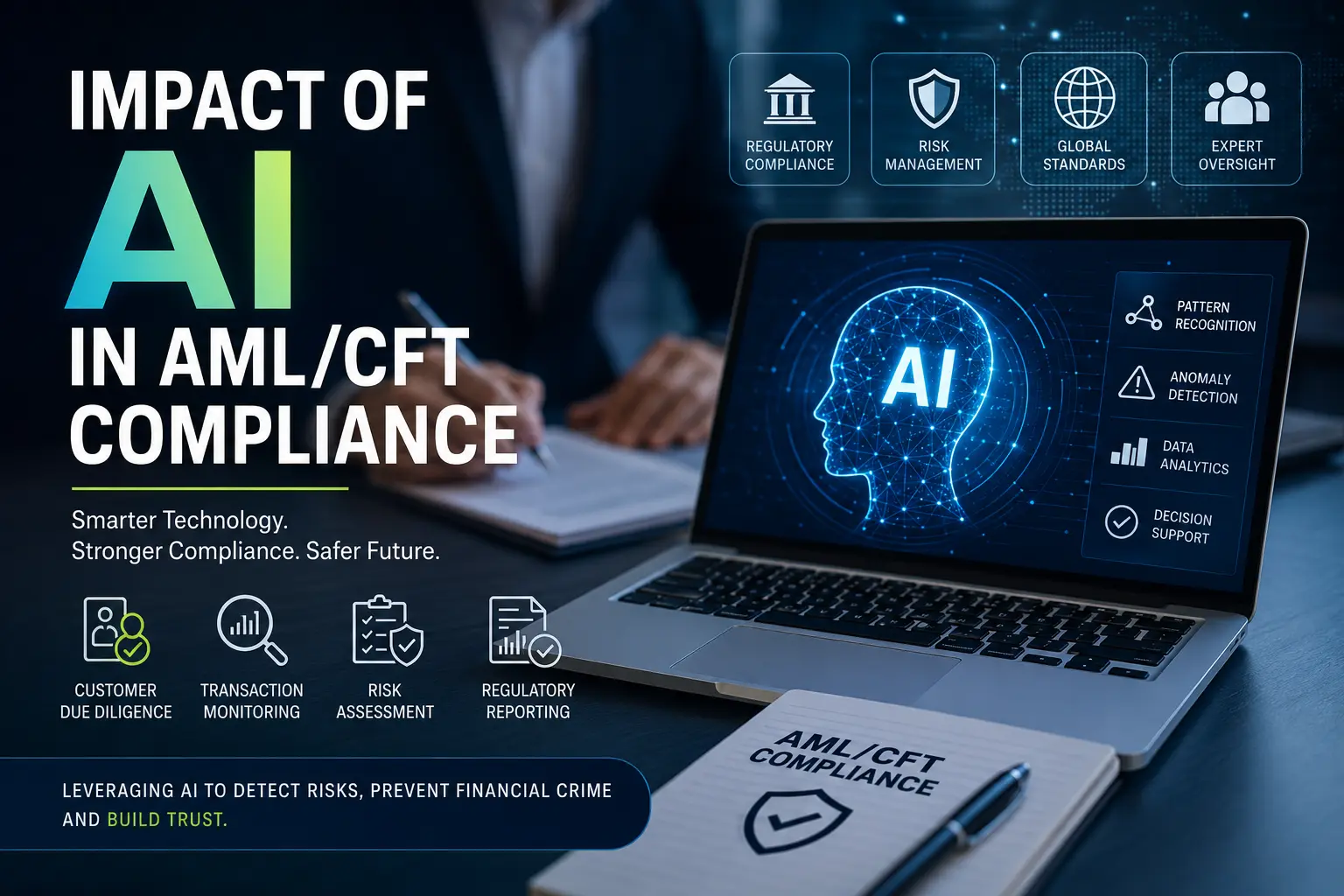
Impact of AI in AML/CFT Compliance: Revolutionizing Financial Crime Prevention
Money laundering and terrorist financing have evolved significantly over the past decade. As financial transactions become increasingly digital and businesses expand across international markets, criminals continue to adopt more sophisticated methods to conceal illicit activities. This growing complexity has placed enormous pressure on regulated businesses to strengthen their Anti-Money Laundering (AML) and Countering the Financing of Terrorism (CFT) compliance programs.
For many organizations, traditional compliance processes are no longer sufficient on their own. Manual reviews, static risk scoring models, and rule-based monitoring systems often struggle to keep pace with today’s transaction volumes and rapidly changing risk landscape. Compliance teams are expected to review more data, identify emerging threats faster, and meet increasingly demanding regulatory expectations—all while maintaining operational efficiency.
This is where Artificial Intelligence (AI) is beginning to make a meaningful difference.
AI is not replacing compliance professionals. Instead, it is providing them with better tools to analyse large volumes of information, detect suspicious patterns that may otherwise go unnoticed, and make more informed risk-based decisions. When implemented responsibly, AI enables organizations to strengthen their compliance framework while allowing experienced professionals to focus their attention where it matters most.
For corporate service providers, financial institutions, trust companies, virtual asset service providers, and other regulated entities, AI is rapidly becoming an important component of modern AML/CFT compliance.
Why AML/CFT Compliance Is Becoming More Challenging
Regulatory expectations continue to increase worldwide as governments strengthen efforts to combat money laundering, terrorist financing, sanctions evasion, corruption, tax crimes, and other financial offences.
At the same time, businesses are dealing with several operational challenges, including:
- Larger customer databases
- Faster digital onboarding processes
- Higher transaction volumes
- Cross-border business relationships
- Increasing sanctions requirements
- More frequent regulatory inspections
- Greater expectations for ongoing monitoring
Many compliance departments still rely on systems that generate thousands of alerts based on predefined rules. While these systems remain valuable, they often produce a significant number of false positives—alerts that require manual review but ultimately present little or no actual risk.
The result is a growing workload for compliance teams, longer customer onboarding times, higher operational costs, and reduced efficiency.
Artificial Intelligence offers an opportunity to address many of these challenges by improving the quality of risk analysis rather than simply increasing the number of alerts.
Understanding the Role of AI in AML/CFT Compliance
Artificial Intelligence refers to computer systems capable of processing information, identifying patterns, learning from historical data, and supporting decision-making with minimal human intervention.
Within AML/CFT compliance, AI should not be viewed as a replacement for existing compliance programs. Instead, it serves as an enhancement to traditional controls by helping organizations analyse significantly larger amounts of information than would be possible through manual review alone.
Unlike conventional rule-based systems that trigger alerts only when predefined thresholds are exceeded, AI can evaluate relationships between customers, transaction behaviour, geographic exposure, ownership structures, and historical activity to identify patterns that may indicate elevated risk.
This allows organizations to move beyond simple rule matching and adopt a more intelligent, risk-based approach to compliance.
From Rule-Based Monitoring to Intelligent Risk Detection
Traditional AML monitoring systems operate using predefined rules.
For example:
- Transactions exceeding a specific monetary threshold
- Multiple cash deposits within a short period
- Transfers involving high-risk jurisdictions
- Unusual account activity
These rules remain essential, but they often lack context.
Imagine two customers transferring similar amounts of money overseas. A traditional monitoring system may flag both transactions equally because they exceed a predefined threshold.
An AI-powered monitoring system, however, considers a much broader range of information before determining whether the activity is genuinely unusual.
It may analyse factors such as:
- Previous transaction history
- Customer occupation
- Source of wealth
- Business activities
- Geographic exposure
- Transaction frequency
- Historical behaviour
- Connections with other entities
Rather than generating alerts solely because a rule has been triggered, AI evaluates the overall behavioural profile of each customer.This enables compliance teams to focus on genuinely suspicious activity instead of spending valuable time investigating routine transactions.
AI Is Enhancing Customer Due Diligence
Customer Due Diligence (CDD) remains one of the most important components of every AML/CFT framework.
Historically, onboarding new customers has required compliance teams to manually review identification documents, verify beneficial ownership information, assess business activities, evaluate risk levels, and collect supporting documentation.
Although these procedures remain essential, they are often time-consuming and resource-intensive.
Artificial Intelligence is helping streamline many of these processes without compromising regulatory standards.
For example, AI can assist organizations by:
- Reviewing identity documents for inconsistencies.
- Identifying incomplete onboarding information.
- Detecting discrepancies across multiple data sources.
- Supporting beneficial ownership analysis.
- Highlighting higher-risk customer profiles for enhanced review.
- Improving consistency throughout the onboarding process.
It is important to emphasize that AI does not make the final compliance decision. Instead, it provides compliance professionals with more accurate information so they can exercise informed judgement based on regulatory requirements and organizational risk appetite.
As a result, businesses can improve both customer experience and compliance efficiency without sacrificing governance.
Smarter Risk Assessments Through Artificial Intelligence
One of the greatest strengths of AI lies in its ability to improve risk assessments.
Every regulated business is expected to adopt a risk-based approach to AML/CFT compliance. However, assessing risk is rarely straightforward. Customer profiles evolve, business relationships change, regulations are updated, and new threats emerge continuously.
Traditional risk scoring models are often static, relying on fixed criteria established during onboarding. AI introduces a more dynamic approach by continuously evaluating new information and identifying changes that may alter a customer’s overall risk profile.
Rather than reviewing customers only at scheduled intervals, AI can help compliance teams identify meaningful changes in behaviour as they occur. This allows organizations to respond more quickly to emerging risks and maintain more accurate, up-to-date customer risk profiles throughout the business relationship.
AI Is Redefining Transaction Monitoring
Transaction monitoring has always been one of the most demanding aspects of an AML/CFT compliance programme. Every day, regulated businesses process thousands of transactions, many of which appear ordinary on the surface but may require closer examination when viewed in context.
Historically, compliance systems have relied on predefined rules to identify potentially suspicious activity. While this approach remains important, it often produces large volumes of alerts that require manual investigation. In many organisations, compliance officers spend considerable time reviewing alerts that ultimately prove to be legitimate customer activity.
Artificial Intelligence introduces a more intelligent approach.
Rather than evaluating transactions individually, AI can analyse customer behaviour over time, identify relationships between multiple accounts, recognise unusual transaction patterns and detect subtle anomalies that may not trigger traditional rules.
For example, instead of simply flagging every transfer above a certain monetary threshold, AI can recognise when a customer’s behaviour suddenly changes. An account that has historically processed only domestic payments may unexpectedly begin sending multiple international transfers to jurisdictions that present higher financial crime risks. Even if each transaction falls below a reporting threshold, the behavioural change itself may warrant additional review.
This contextual analysis helps compliance teams focus on higher-risk activities while reducing the number of unnecessary investigations.
Reducing False Positives Without Reducing Compliance
One of the biggest frustrations shared by compliance professionals is the high number of false-positive alerts generated by conventional monitoring systems.
Every unnecessary alert consumes valuable time and resources. Investigators must review customer records, analyse transaction history, document their findings and ultimately determine that no suspicious activity exists.
AI can significantly improve this process by learning from historical investigations and identifying characteristics commonly associated with genuine financial crime.
This does not mean fewer controls. Instead, it means smarter controls.
By prioritising higher-risk alerts, organisations can improve operational efficiency while maintaining strong regulatory oversight.
For businesses experiencing rapid growth or managing large customer portfolios, this can make a significant difference to the effectiveness of their compliance programme.
AI Supports Better Sanctions and PEP Screening
Sanctions compliance continues to receive increasing attention from regulators worldwide.
Businesses are expected to screen customers against sanctions lists, politically exposed persons (PEPs), adverse media and other risk indicators throughout the customer relationship.
Traditional screening systems frequently generate duplicate matches because of spelling variations, transliterations and common names. Compliance teams then spend considerable time determining whether a match represents genuine risk or a false positive.
AI-powered screening technologies can improve this process by analysing additional contextual information rather than relying solely on exact name matches.
This enables organisations to:
- Improve matching accuracy.
- Reduce duplicate alerts.
- Identify hidden relationships between entities.
- Prioritise higher-risk cases.
- Support more effective ongoing monitoring.
The result is a more efficient screening process without compromising regulatory obligations.
AI Cannot Replace Human Judgement
Despite its impressive capabilities, Artificial Intelligence should never be viewed as a replacement for experienced compliance professionals.
AML/CFT compliance is not simply about analysing data. It requires professional judgement, regulatory interpretation, ethical decision-making and an understanding of business context that technology alone cannot provide.
An AI model may identify unusual behaviour, but determining whether that behaviour is genuinely suspicious still requires the expertise of trained compliance professionals.
This is particularly important when organisations must decide whether to escalate an investigation, perform Enhanced Due Diligence (EDD) or submit a Suspicious Activity Report (SAR).
Technology can support these decisions, but accountability remains with the organisation and its compliance function.
The strongest compliance programmes therefore combine intelligent technology with experienced people rather than relying exclusively on either.
Challenges Organisations Should Consider Before Implementing AI
Although AI offers significant opportunities, successful implementation requires careful planning.
Organisations should first ensure that their existing compliance framework is well established. AI performs best when supported by high-quality customer data, documented policies, effective governance and clearly defined compliance procedures.
Several practical considerations should also be addressed.
Data Quality
Artificial Intelligence relies heavily on accurate information. Incomplete or inconsistent customer records can reduce the effectiveness of AI models and increase the likelihood of inaccurate conclusions.
Governance and Accountability
Organisations remain responsible for every compliance decision they make, regardless of the technology they use. AI should enhance governance—not replace it.
Transparency
Compliance professionals should understand how AI supports risk decisions. Transparency is essential for internal oversight and regulatory confidence.
Information Security
AI systems often process sensitive customer information. Appropriate cybersecurity measures, access controls and data protection policies remain critical components of any compliance programme.
The Future of AML/CFT Compliance
Financial crime will continue to evolve, and compliance programmes must evolve alongside it.
Artificial Intelligence is expected to play an increasingly important role in behavioural analytics, predictive risk modelling, intelligent customer onboarding and continuous monitoring.
However, technology alone will never create an effective compliance culture.
Strong governance, ongoing employee training, independent oversight and a risk-based approach will remain the foundations of successful AML/CFT compliance.
Organisations that embrace technology while maintaining these principles will be better equipped to respond to changing regulatory expectations and emerging financial crime risks.