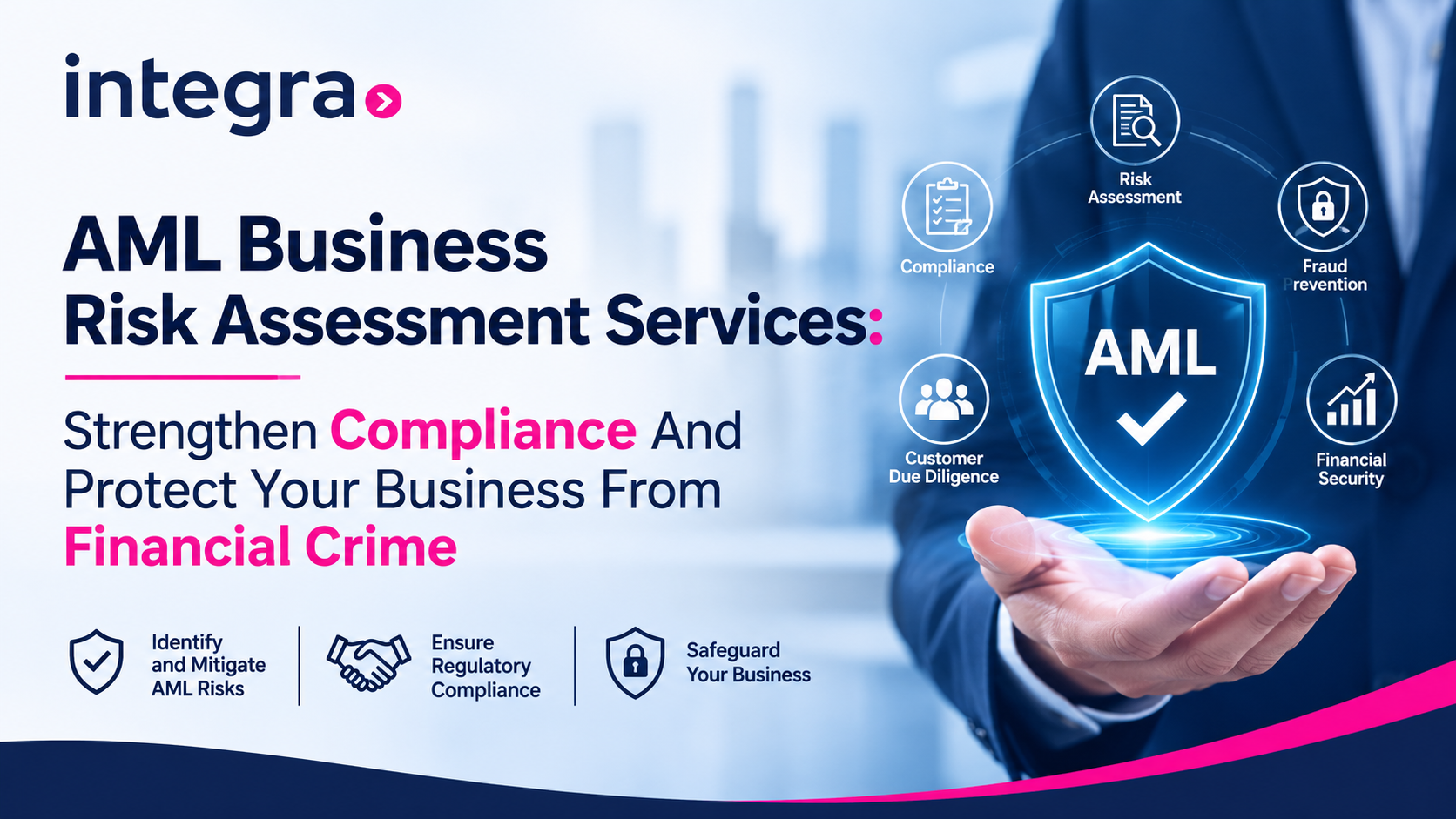
In today’s increasingly complex regulatory environment, businesses must take proactive steps to identify and manage the risks associated with money laundering and terrorist financing. Whether operating in financial services, corporate administration, investment management or other regulated sectors, understanding potential financial crime exposure is essential for maintaining compliance and protecting business integrity. This is where AML Business Risk Assessment Services play a vital role. A comprehensive Anti-Money Laundering (AML) business risk assessment helps organisations identify vulnerabilities, evaluate their exposure to financial crime and establish appropriate controls to mitigate potential threats. At Integra, we help organisations strengthen their AML/CFT compliance frameworks through practical, risk-based assessment solutions. Our approach focuses on understanding your business activities, identifying relevant risks and developing proportionate measures that support regulatory compliance, operational resilience and better business decisions.
What Is An AML Business Risk Assessment?
An AML Business Risk Assessment (BRA) is a structured process used to identify, analyse and evaluate the risks that an organisation may face in relation to money laundering, terrorist financing and other financial crimes. It provides an organisation with a clear understanding of how its products, services, customers, transactions and geographical exposure could potentially be exploited for illicit financial activities.
Rather than applying the same compliance measures to every customer or business activity, an effective risk assessment enables organisations to adopt a risk-based approach. This means allocating appropriate resources and implementing stronger controls in areas where the exposure is higher. A well-documented business risk assessment also provides an important foundation for developing AML/CFT policies, procedures, internal controls and ongoing monitoring arrangements.
Why Are AML Business Risk Assessment Services Important?
Financial crime risks continue to evolve as businesses expand into new markets, adopt digital services and establish relationships with customers and third parties across different jurisdictions. Without a structured risk assessment, organisations may overlook important vulnerabilities, implement ineffective controls or struggle to demonstrate that their compliance arrangements are appropriate. Professional AML Business Risk Assessment Services help organisations:
- Identify Financial Crime Risks: Understand potential exposure to money laundering and terrorist financing across business operations.
- Strengthen Regulatory Compliance: Align internal risk management practices with applicable AML/CFT requirements and regulatory expectations.
- Improve Internal Controls: Identify weaknesses in existing policies, procedures and compliance measures.
- Support Better Decision-Making: Give management a clearer understanding of risk exposure and appropriate mitigation strategies.
- Allocate Resources Effectively: Direct compliance resources towards higher-risk customers, activities, products and jurisdictions.
- Enhance Business Resilience: Reduce vulnerabilities and strengthen the organisation’s ability to respond to emerging threats.
Ultimately, an effective assessment is not simply a compliance document. It is a practical management tool that supports informed decisions and long-term business stability.
Key Areas Covered In An AML Business Risk Assessment
A comprehensive assessment should consider the different factors that may expose an organisation to financial crime. These factors will vary depending on the nature, size and complexity of the business.
1. Customer Risk
Understanding who your customers are is fundamental to identifying potential money laundering risks. The assessment should consider customer profiles, ownership structures, business activities, source of funds and other relevant risk indicators. Customers with complex ownership arrangements, politically exposed person (PEP) connections or links to higher-risk jurisdictions may require enhanced due diligence, depending on the circumstances.
2. Product And Service Risk
Different products and services carry different levels of financial crime exposure. Certain services, particularly those involving complex transactions, significant financial movements or corporate structures, may present additional vulnerabilities. Assessing these risks helps organisations determine whether existing controls are sufficient and whether additional safeguards are required.
3. Geographical Risk
Operating across multiple countries or dealing with international customers can introduce additional AML/CFT risks. A business risk assessment should consider the jurisdictions in which the organisation operates, its customer base and the geographical origin or destination of transactions. Relevant country risk indicators and applicable regulatory guidance should inform the assessment.
4. Delivery Channel Risk
The methods used to establish and maintain customer relationships can influence an organisation’s financial crime exposure. Remote onboarding, digital transactions, intermediaries and third-party service providers may introduce additional risks that require appropriate identification, verification and monitoring procedures.
5. Transaction Risk
Organisations should also evaluate the types, frequency, volume and complexity of transactions they process. Unusual transaction patterns, inconsistent financial activity and transactions involving higher-risk jurisdictions may indicate potential vulnerabilities. Appropriate monitoring arrangements help organisations identify and investigate suspicious activity.
How Integra Supports Your AML Business Risk Assessment Requirements
At Integra, we recognise that effective risk management requires more than identifying potential threats. Organisations need practical solutions that translate risk findings into meaningful compliance improvements. Our AML Business Risk Assessment Services are designed to help businesses understand their exposure to money laundering and terrorist financing and establish appropriate measures to manage identified risks. Our support includes:
- Business Risk Identification: Identifying relevant AML/CFT risks associated with your customers, products, services, delivery channels and geographical exposure.
- Risk Assessment and Evaluation: Analysing identified risks to establish their potential significance and prioritise areas requiring attention.
- Risk Mitigation Recommendations: Recommending proportionate controls and practical measures to address identified vulnerabilities.
- AML/CFT Framework Alignment: Supporting the development of relevant policies, procedures and internal controls based on your organisation’s risk profile.
- Ongoing Assessment Support: Helping businesses review and update their assessments as operations, regulatory requirements and risk exposures evolve.
Our approach is tailored to your organisation’s business model, regulatory environment and strategic objectives. This ensures that the assessment remains relevant, practical and capable of supporting day-to-day compliance activities.
The Importance Of Regular AML Risk Assessment Reviews
An AML business risk assessment should not be treated as a one-time exercise. Business activities, customer profiles, regulatory expectations and financial crime threats can change over time. Regular reviews help organisations identify emerging risks and determine whether existing controls remain effective. An assessment should be reconsidered when significant changes occur, such as:
- Introducing new products or services.
- Entering new geographical markets.
- Experiencing substantial changes in customer profiles.
- Adopting new technologies or delivery channels.
- Identifying weaknesses in existing compliance controls.
- Responding to changes in applicable regulatory requirements.
By maintaining an up-to-date assessment, organisations can ensure that their AML/CFT framework continues to reflect their actual risk exposure.
Strengthen Your AML Compliance Framework With Integra
Effective AML risk management is essential for protecting your organisation, maintaining regulatory confidence and supporting sustainable business growth. Integra combines practical compliance expertise with a risk-based approach to help organisations identify vulnerabilities, strengthen internal controls and make better-informed decisions.
Our wider risk management capabilities also support enterprise risk management, compliance risk assessments, operational risk management and operational resilience. This integrated perspective helps organisations understand how compliance risks connect with broader business performance and long-term objectives. Whether you are establishing your first business risk assessment, reviewing an existing framework or strengthening your AML/CFT controls, Integra can help you determine the right approach.